



The Quintino Sella was an Italian destroyer, built in 1935, that served in the Royal Navy during World War II.
These units were the first destroyers designed in Italy after the end of World War I. In the development of the design, the experience gained in the wartime use of this type of torpedo boat was duly taken into account, as well as the prevailing trends followed at that time by the main navies regarding destroyers.
 Compared to similar units of earlier design, the “Sella” class was enhanced:
- in displacement, which approached 1500 tons at full load;
- in contractual speed, which was raised to 35 knots;
- in main artillery armament, adopting a caliber of 120 mm;
- in torpedo armament, with the adoption of 533 mm torpedoes.
Practically, these destroyers, in terms of size and armament, equaled or surpassed the units of earlier construction known as “scouts” in the Italian Navy, “éclaireurs légers” by the French, “flotilla leaders” by the British, and “Flottillenführerschiffe” by the Germans.
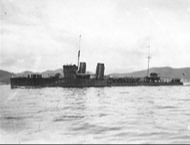 Equipped with more powerful, modern, and refined engine systems, the “Sella” class developed significantly higher speeds than those previously achieved by scouts. During acceptance trials, with a displacement of around 1050 tons, they greatly exceeded the contractual speed; the fastest unit of this class, the Crispi, reached an average of 38.6 knots during official trials at full power (lasting three hours).
The internal compartmentalization of these destroyers represented a further improvement compared to those of earlier designs; the hull, in its central part, was divided into six watertight compartments between two longitudinal bulkheads and seven transverse bulkheads.
The “Sella” were experimentally equipped with a mechanical fire control system Salvagnini, with a French SFT type fire control and Siemens transmitters, which could also be used for night firing.
In terms of armament, as already mentioned, the adoption of the 120 mm caliber for the main artillery and the 533 mm torpedoes represented a decisive leap towards ever more powerfully armed destroyers. After a few years of service (1929), the single forward mount and the twin aft mount were replaced with light twin mounts of the same caliber, thus adapting the artillery to those of the new destroyers that had already entered service (cf. “Sauro” class). A notable quantity of mines could be carried (from 32 to 40 depending on the type of weapon), without rendering the aft artillery unusable, which in the “Sella” were elevated on the deck by means of a special collar with a corresponding platform.
After 1930, the anti-aircraft armament was enhanced with the addition of two single 13.2 mm machine guns placed on the forecastle.
Regarding the generator and engine system, there was greater simplicity of operation and, above all, a power never before achieved on torpedo vessels (using superheated steam).
 The engine system of the Crispi, consisting of fully action Belluzzo turbines, while well-designed, did not provide the same performance during operation as those of similar units, mainly because the steels used in construction had not yet reached the necessary perfection for such a type of turbine. After eight years of service, in the summer of 1935, the turbines became unusable due to breakdowns and in 1936/37 were replaced with others of the same Belluzzo type, slightly modified, which, built with higher performance materials, confirmed the goodness of the design.
In 1938, during a refit, the Sella experimentally replaced one of the original boilers with another type La Mont with forced circulation, of slightly lower power but high performance, in order to increase autonomy at economical speed.
The experiment proved successful, but the other three units of the class did not undergo similar replacement because negotiations for the transfer of two of them to Sweden had begun and the Crispi had recently undergone significant work; subsequently, the outbreak of World War II overshadowed the matter. The two units of this class that remained with the Italian Navy, after the first wartime experiences, modified the anti-aircraft armament, replacing the old 40/39 machine guns with modern 20/70 Oerlikon; the 13.2 mm machine guns were moved to the aft platform.
Aside from the characteristics already highlighted, these destroyers proved to be quite light in structure and not very stable during operation; in 1927-28, therefore, the weaker parts were reinforced and significant length and width roll fins were applied. With such improvements, the “Sella” became, overall, good destroyers: fairly seaworthy, very maneuverable, comfortable, and relatively simple. However, the modest height of the deck above the sea at full load and the not robust deck fittings posed serious difficulties for navigation in adverse sea conditions.
In the summer of 1926, it undertook a long cruise to Greek ports, the Dodecanese islands, Famagusta, Alexandria, and Tobruk to test the machinery and systems. It was then stationed in Livorno at the disposal of the Naval Academy, raising the flag of the Group Leader of the units assigned to the training of cadets. At the end of February 1927, it was replaced by the Cascino and became part of the 7th (later 4th) Torpedo Squadron of the Fleet. In 1928, it briefly visited Majorca; in 1929 it undertook a cruise with the Riccasoli and Nicotera to the Mediterranean and Atlantic ports of Spain, reaching as far as Lisbon and returning to metropolitan waters after stopping in Tripoli. Also in 1930-31, it undertook summer cruises in the Dodecanese and in Greek ports with units of the 1st Fleet. It was then assigned to the 2nd Fleet as a divisional reserve unit in Taranto. In August 1932, it became part of the 6th Division (in Venice), remaining there for over three years and conducting training activities mainly in the Upper Adriatic.
After a brief assignment to the Departmental Forces of La Spezia in the early months of 1936, it was sent to the Aegean for service in that Possession and connections with Cyrenaica. Returned to metropolitan waters at the end of 1937, it was assigned to the 4th Departmental Squadron based in Brindisi, conducting modest local activities.
In May 1939, the units of the 4th Squadron were transferred to La Spezia. During the summer of the same year, the Sella was stationed in the Dodecanese.
At the outbreak of war in Italy, the unit was therefore in the Aegean where it primarily carried out its wartime activities.
After the start of hostilities against Greece, it participated in the occupation of various Greek islands, also intensifying the protection service for traffic in the Aegean.
The wartime activity involved 116 escort missions in addition to a dozen missions of various kinds, including some offensive ones to intercept British forces during the operations in Crete; in carrying out this activity, the destroyer covered 44,000 miles in areas intensely contested by the enemy.
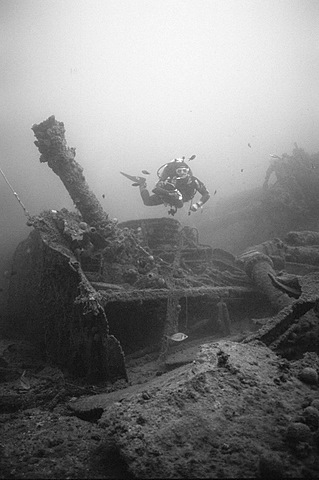
At the time of the armistice, the Sella was in Venice for repairs. On September 11, it set sail to move south, but about 30 miles from Lido, it was attacked by a German motor torpedo boat – concealed behind a passing steamer in the area – and, hit squarely by two torpedoes, sank rapidly.