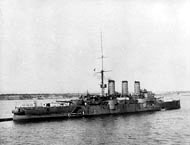
 The armored cruiser Amalfi was sunk by a torpedo launched by an Austrian submarine, lying in wait about 20 miles off the Italian coast.
Launched in 1908 by the Odero shipyards in Genoa, it was 140 meters long, 21 meters wide, and weighed 9,832 tons when fully loaded. The term "Armored" comes from the fact that it was surrounded by a nickel-chromium steel protection up to 20 centimeters thick. To counter the raids of the Austrian torpedo boats based in Pola, it was decided that a naval squadron escorted by the cruiser Amalfi would patrol just off the Istrian coasts.
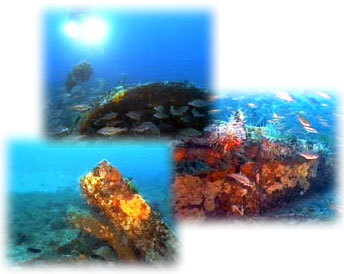
The torpedo was therefore launched with extreme precision and struck the ship on the left side, corresponding to the central compartment of the coal boilers which, operating 2 four-cylinder reciprocating engines, provided a power of 20,000 horsepower and allowed it to reach the then staggering speed of 23 knots. Chronicles recount that after only 6 minutes the ship had already completely capsized and after another 4 minutes it sank. Despite the short time available, 652 men out of 719 on board managed to save themselves. This was mainly due to the discipline of the crew and the maneuver of Captain Riaudo, commander of the Amalfi, who after the explosion ordered the helm to be turned to starboard, thus containing the effect of the list to the left caused by the breach. Meanwhile, the shipwrecked were picked up by the torpedo boats CALIPSO and PROCIONE that promptly arrived. Before leaving the disaster site, signals were left at the sinking site to allow for further investigations. At a depth of 14 meters lay the keel, while the 2 propellers were at 18 meters on a 30-meter deep seabed. The 3 smokestacks, the 6 twin turrets, and the bridge lay and still lie crushed under the weight of the hull. The steel cladding that enveloped the ship was of no use and can still be admired today. The armor made of nickel-chromium steel, 20 centimeters thick, was placed on the sides at the waterline. From 1924, systematic dismantling began with the recovery of almost all the armored cladding, a real treasure for the post-war metallurgical industry. The 2 bronze propellers were also recovered by the Scavone company from Venice. The demolition, achieved through the detonation of a huge amount of explosives, spared nothing and everything possible was recovered until reaching the deck level. The ship's superstructures are partly covered by mud and dislocated by the explosions. The drawing taken from the text "History of the Navy" published by the Fratelli Fabbri gives a much clearer idea of the ship's structure than can be obtained by observing the few remains scattered on the seabed. In 1986, the wreck was found with considerable difficulty by two Venetian divers; it is worth noting that since the hull had been completely demolished, the signal given by the echo sounder highlighted a depression on the seabed with obstacles no taller than 1 meter. Unfortunately, such systematic recovery work has deprived divers of our time of an incomparable spectacle.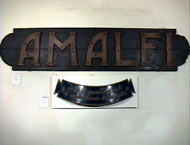 In 1919 and 1921, after the war ended, attempts were made to locate the wreck, but the estimated point and the limited search systems made the operation quite difficult. Using the dragnet method, dragging a 300-meter steel cable, it took a long time before something got caught in the search hooks. To the first diver who immersed, the ship appeared completely capsized, sunk in the mud up to the deck level.